
Bunkering is planned. Cargo discharge is planned. Maintenance has its own work controls. Each team can explain how its job will be managed, yet the combined plan may depend on the same watchkeeper, the same access route or equipment that another team intends to isolate. Those dependencies are where a simultaneous-operations review earns its value.
An operation assessed as acceptable under one set of conditions may become unacceptable when another activity changes those conditions. SIMOPS assessment therefore needs to examine the interaction between tasks, including work that appears minor or does not require a permit. HSE's permit-to-work guidance explicitly addresses hazards that one activity can create for another, whether or not both activities need permits.[1]
Find what the operations share
Start with the proposed work sequence and the actual ship and berth arrangement. Identify which people, working areas, access routes, communications and protective systems each operation requires. Then ask what another activity could change. A maintenance isolation might remove equipment relied on by the bunkering plan. A cargo movement might place a suspended load above a transfer hose. A temporary work area might obstruct the route needed to reach emergency equipment.
The interaction can also be less visible. Two task plans may each assume that an officer is continuously available, without checking whether those commitments overlap. A person cannot provide undivided attention to two demanding activities at once. Counting the same resource in both plans creates a capacity problem even when the work areas are physically separated.
EMSA's biofuel-bunkering guidance discusses simultaneous cargo operations, zoning, dedicated personnel and ship–shore communication.[2] Those considerations provide useful prompts, but the fuel and local arrangements matter. A plan suitable for one fuel or berth cannot be transferred unchanged to another, and an assessment cannot override applicable port restrictions or vessel requirements.
Test the combined plan against a change
Consider a hypothetical bulk carrier bunkering liquid fuel while discharging cargo. The initial plan keeps lifting clear of the bunker hose and preserves access to the manifold. A maintenance team is also working on deck within an agreed boundary. The three activities have been discussed together, with named people responsible for the interfaces.
A cargo-handling problem then requires the crane to move to another working position. The proposed lifting route approaches the bunker connection, while the maintenance boundary narrows an alternative access route. Nothing has failed in the fuel-transfer equipment, but two assumptions supporting the agreed overlap have changed.
The coordination arrangement should make that change visible before the lift begins. The teams may need to sequence the work differently, move the maintenance boundary through an authorised change, or suspend an affected operation in its agreed safe state. Which option is acceptable depends on the actual hazards and applicable restrictions. A generic instruction to proceed carefully would leave the changed interface unresolved.
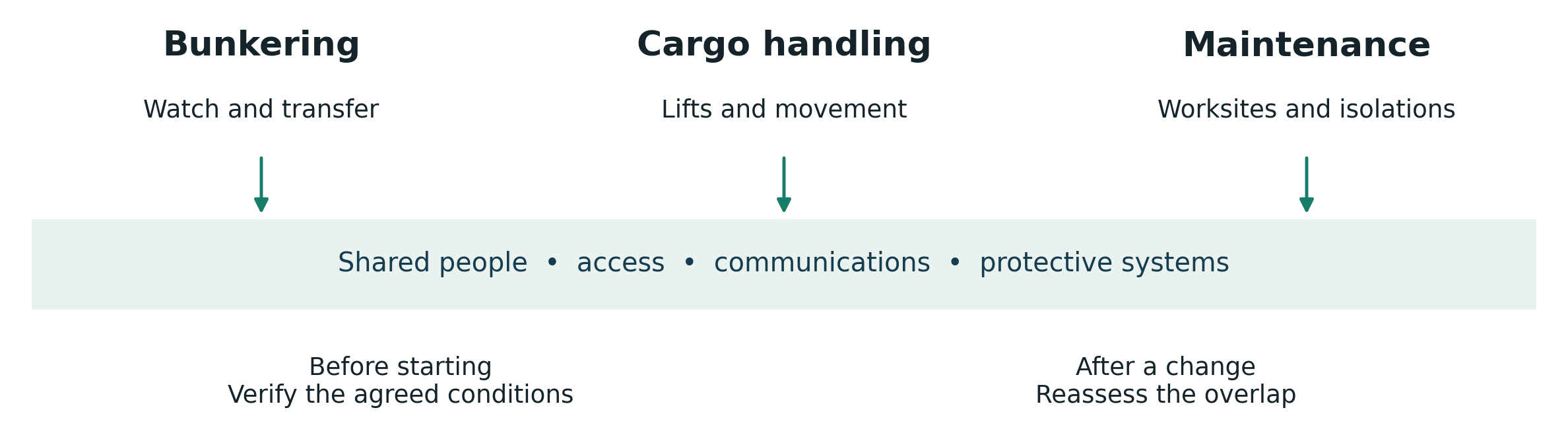 Figure 1. Concurrent operations depend on shared conditions. Original ICORA MED conceptual illustration informed by references 1–3. The dependencies shown are examples, not an approval matrix or an exhaustive checklist.Source: ICORA MED
Make the conditions for overlap explicit
A useful SIMOPS review produces a bounded operating arrangement. It identifies which activities may overlap, where and when they may occur, which services stay available and who maintains the shared picture. Each condition needs an owner who can verify it. For example, the person coordinating cargo work needs to know which proposed changes require consultation with the bunkering team before execution.
Permits can support that coordination when linked to the relevant work, isolations and operating restrictions. HSE emphasises that a permit is a communication and coordination mechanism, and that issuing it does not itself make the work safe.[3] Its guidance comes from other industries and is used here as a transferable management principle, not as a standalone maritime requirement.
Include changes of shift, contractors and shore personnel in the communication arrangement. A departing supervisor may understand why an access route is kept clear; a replacement may see only an apparently unused space. The handover should preserve the reason for the restriction, the current equipment state and the conditions governing the combined operation.[4]
Agree how to stop and how to restart
Before work begins, agree how anyone who sees an unsafe interaction can raise the alarm and initiate the established stop-work process. Identify who directs a safe suspension, how the other teams are notified and who authorises restart. The ISM Code requires these arrangements to preserve the master's overriding authority and responsibility for decisions concerning safety and pollution prevention.[5] Coordination does not transfer that authority to a workshop facilitator or checklist owner.
Set practical triggers tied to the assessment: loss of agreed communications, an unplanned movement into a controlled area, an unavailable essential resource or a change in the work scope. The appropriate response may affect one operation or several. Bringing work to a safe state needs the relevant procedures; an abrupt, uncoordinated stop can itself create problems.
Restart should be a positive decision after the changed conditions have been assessed and controls verified. A suspended maintenance permit can still carry active isolations, so silence or a pause does not establish that equipment is available. HSE's guidance requires verification and permit revalidation or replacement before suspended work restarts.[1]
SIMOPS assessment does not lead to a universal prohibition on doing two things at once. It establishes whether a particular combination is supportable, within defined limits. The useful question at the next planning meeting is: what does each operation assume will remain available, and could another job remove it?
Sources and further reading
Primary sources checked 15 October 2026. Refer to the current vessel-specific safety management system and applicable flag, port and class requirements.
Paragraphs 19–22 cover suspension, restart and interacting activities; paragraph 35 addresses coordination. Petroleum, chemical and allied-industry guidance.
Section 6.7, pages 41–42, covers SIMOPS considerations. Sections 7.1.3–7.1.4 discuss port, flag and class roles. Guidance is not a universal permission to conduct SIMOPS.
Coordination, communication, responsibility and limits of the permit itself.
Communication of task-relevant information between shifts and teams, based on the needs of incoming personnel.
Section 5.2 establishes the master's overriding authority. The linked adoption resolution is cited for this provision; use the current Code and applicable implementation for compliance.
This article is provided for professional information only. It does not constitute project-specific technical, engineering or regulatory advice.