Ammonia is increasingly being considered as a marine fuel. Its use, however, introduces a safety challenge that differs materially from that of conventional fuels. The central concern is not only fire or explosion: a loss of containment can create acute toxic exposure, affecting personnel, escape routes, vessel operations, and emergency response.
This article provides an overview of the safety landscape associated with the use of ammonia as a marine alternative fuel and organizes ammonia-fuel safety around four interconnected principles: (i) prevent release, (ii) prevent hazardous accumulation and exposure, (iii) detect releases early, and (iv) contain consequences.
Ammonia: a toxicity-led hazard
Ammonia is toxic and corrosive. What separates it from conventional marine fuels is the concentration at which it becomes dangerous. Occupational exposure limits are set in the tens of parts per million, and a few hundred parts per million is enough to be immediately dangerous to life or health. A quantity of ammonia far too small to threaten the ship can still be enough to incapacitate the people working near it.
Ammonia gives its own early warning: it has a sharp odour, detectable well below harmful concentrations. That warning is not a measurement. At high concentrations the sense of smell dulls within minutes, so a weakening smell does not mean a falling concentration.
Ammonia is also flammable, but within a narrow concentration range and with a high ignition energy, so sustained ignition in open air is difficult. Flammability and explosion still require assessment where confinement, mixing with air, and ignition sources could coincide. Refrigerated liquid ammonia is carried at about −33 °C, cold enough to injure on contact and to embrittle materials not selected for the duty. Ammonia also attacks copper, brass and zinc, which constrains material selection throughout the system.
Taken together, these properties leave acute toxicity as the dominant driver of the ammonia safety case in maritime applications.
A credible event can be expressed simply:
Loss of containment → ammonia release → toxic cloud or direct contact → personnel exposure → injury or incapacitation
The safety objective is therefore broader than maintaining equipment integrity. It also extends to preventing released ammonia from reaching people, accommodation openings, air intakes, control spaces, escape routes, muster areas, life-saving appliances, and emergency responders.
This systems perspective shapes the arrangement and design of the installation. The probability and consequences of ammonia-related hazards are limited through containment, ventilation, detection, toxic-area management, and safety actions, and through preventing unintended toxic or flammable concentrations and minimising ammonia-release sources.
1. Prevent release
The first and most effective safety measure is to prevent loss of containment.
For ammonia systems, this concerns the integrity of tanks, piping, valves, flanges, seals, transfer hoses, bunkering connections, fuel-preparation equipment, and pressure-relief arrangements. It also depends on appropriate material selection, fabrication quality, installation, commissioning, inspection, testing, maintenance, and operational discipline.
Potential failure mechanisms are considered throughout the operating life of the system. These include corrosion and stress-corrosion cracking, vibration, thermal cycling, mechanical damage, seal degradation, valve malfunction, incorrect line-up, overfilling, and errors during bunkering connection or disconnection. The objective is practical: to reduce the likelihood, magnitude, and duration of credible releases.
Not every release comes from a failure. Routine operations open the system deliberately — bunkering connection and disconnection, purging, sampling, draining and maintenance — and these account for a substantial share of the occasions on which people are close to ammonia. Procedures, competence and supervision carry as much of this principle as equipment does.
This principle has a clear design implication. Ammonia-containing equipment not only withstands normal operating conditions; it is also arranged so that foreseeable failures do not readily expose people or allow ammonia to migrate into spaces intended to remain free from ammonia contamination.
Containment applies across fuel storage, supply, and bunkering arrangements. Potential release sources are arranged so that releases can be managed through recovery or treatment systems, or directed to an assessed safe open-air location.
Note
Open-air discharge is not inherently safe. The discharge location, release rate, wind conditions, ship geometry, nearby personnel, neighbouring vessels, and shore-side operations are all considered.
2. Prevent hazardous accumulation and exposure
If a release occurs, the critical question is where ammonia may travel and who could be exposed.
For ammonia, preventing hazardous accumulation and preventing hazardous exposure are closely linked, but they are not identical. A release in open air may not accumulate within an enclosed space, yet it can still create a hazardous toxic plume. The risk is therefore not confined to the immediate release point.
How the release behaves matters as much as where it begins. Ammonia vapour on its own is lighter than air and tends to rise. A release of liquid or pressurised ammonia does not behave that way: it flashes into a cold aerosol that is denser than the surrounding air, and that cloud can travel at deck level and gather in low or sheltered areas before it warms and lifts. Treating ammonia as a gas that always disperses upwards underestimates where it can reach.
Ammonia vapour may enter or affect accommodation spaces, ventilation intakes, bridge areas, machinery spaces, control stations, escape routes, muster stations, neighbouring vessels, or shore-side personnel.
Ship layout is therefore a primary safeguard. The locations of fuel tanks, tank connection spaces, fuel-preparation rooms, bunker stations, vent outlets, air intakes, openings, accommodation boundaries, escape routes, and life-saving appliances are assessed together.
Ventilation is important, but it is not sufficient on its own. The full release pathway is considered, including compartment geometry, obstructions, external wind, mechanical-ventilation performance, ducts, openings, airflows, and potential routes into occupied spaces. Where possible, releases are directed away from people and critical ship functions.
Dispersion analysis can provide valuable support. Its role is not limited to drawing gas-concentration contours. It can inform decisions on toxic-area extent, vent location, detector placement, bunkering safety zones, access control, escape routes, and emergency arrangements.
Air intakes, outlets, openings into non-toxic spaces, muster stations, and life-saving equipment are protected from toxic areas. The European Maritime Safety Agency has identified ship-specific dispersion analysis as an important basis for assessing the protection of accommodation and machinery spaces, escape routes, muster stations, bunkering zones, detector locations, and personal protective equipment requirements.
3. Detect releases early
Early detection provides the time needed to take protective action before exposure becomes severe or the event develops into a wider emergency.
Detection for ammonia is set by a different measure from detection for a conventional fuel. Ammonia becomes hazardous to people at concentrations far below its flammable range, so alarm levels follow exposure thresholds in parts per million rather than a percentage of the lower flammable limit. A system arranged to warn of a fire risk would allow a serious toxic exposure long before it responded.
An effective detection strategy combines fixed ammonia-gas detection in relevant spaces with portable gas detectors and, where justified by the task and exposure risk, personal monitors for personnel involved in bunkering, maintenance, inspection, and emergency response. Liquid-leak detection, pressure and flow monitoring, ventilation-status alarms, and fire detection can provide further warning of abnormal conditions.
The main question is not simply whether ammonia can be detected. It is whether the release can be detected early enough, in the right location, and with a response that reduces harm.
Alarm set-points and associated actions are established for credible scenarios. Depending on the event, the response may include stopping bunkering, isolating the fuel supply, closing valves, adjusting ventilation, restricting access, raising alarms, evacuating personnel, or activating onboard and shore-side emergency-response arrangements.
Detection has limited value unless it leads to timely and effective action, which is why control, alarm, monitoring, shutdown, and fixed ammonia-gas or leakage-detection systems are specified together for the relevant spaces and areas.
4. Contain consequences
If prevention and detection do not fully succeed, the next priority is to limit the impact of the release.
For ammonia, containing consequences means controlling the source, limiting the available inventory, managing the spread of liquid or vapour, reducing exposure, and protecting essential ship functions. It does not mean simply trapping ammonia in an enclosed space; uncontrolled confinement could intensify toxic exposure and, under some conditions, introduce additional flammability concerns.
Relevant measures may include emergency shutdown, rapid fuel isolation, sectionalisation, controlled depressurisation where justified by the safety analysis, and venting through a designated system to a location assessed as safe for the vessel, personnel, nearby vessels, and shore-side operations. Other measures may include secondary containment, spill collection, segregated drainage, gastight boundaries, airlocks, and protection of spaces intended to remain free from ammonia contamination.
Ammonia's solubility in water shapes what response is effective. A water spray or curtain absorbs ammonia vapour readily and can reduce the extent of a cloud. Water applied directly to a liquid pool has the opposite effect: it adds heat and increases vaporisation. The resulting ammonia solution is itself a pollutant, so drainage and collection form part of the arrangement rather than an afterthought.
People remain central to this final layer of protection. Effective arrangements include restricted-area management, safe access and escape, evacuation procedures, protected muster or refuge arrangements where provided, respiratory protection, decontamination facilities, rescue capability, and trained responders.
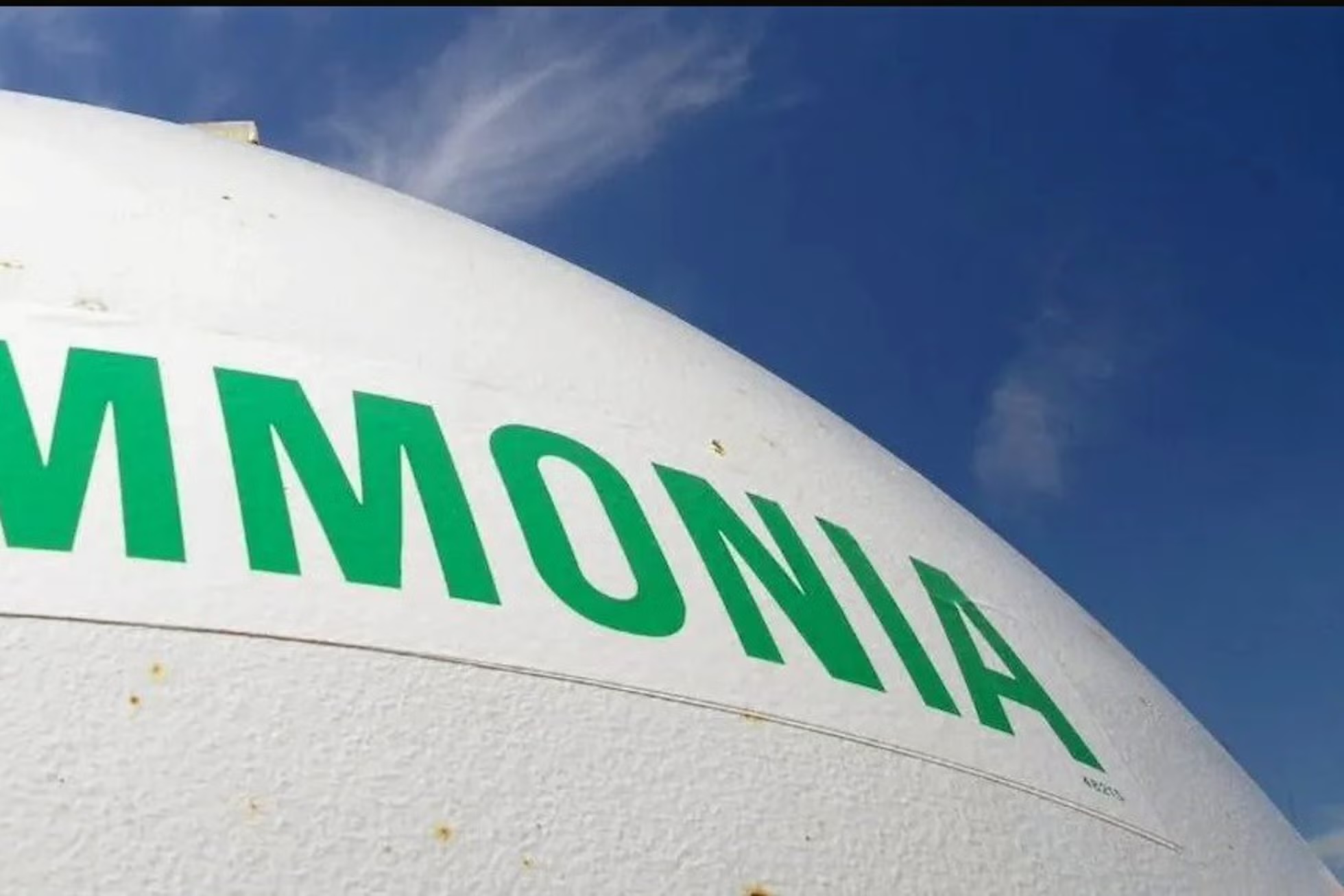 A storage tank marked for ammonia.
The ammonia bunkering interface also requires clear coordination between the vessel, terminal, port authority, and external emergency services. Emergency arrangements address both vessel-specific hazards and the wider consequences of a release in port or during simultaneous operations.
Preventing leakage into non-toxic spaces, managing liquid spills, and providing safe access and rescue belong to this layer, as does ensuring that safety actions following a release do not lead to an unacceptable loss of power.
Closing perspective
Ammonia safety depends on more than preventing a leak. It requires an integrated approach that considers containment integrity, release pathways, vapour dispersion, early detection, personnel protection, and consequence management as connected layers.
The four principles provide a practical structure for this thinking:
- Prevent release.
- Prevent hazardous accumulation and exposure.
- Detect releases early.
- Contain consequences.
The same principles apply to other flammable and toxic fuels. What changes between fuels is the hazard that drives them: for ammonia, acute toxicity; for hydrogen, ignition and explosion; for methyl/ethyl alcohol, a low-flashpoint liquid that is both flammable and toxic.
Their application will vary by vessel type, machinery arrangement, bunkering concept, port interface, and operating environment. The underlying safety questions, however, remain consistent:
Key points
- Where could ammonia be released?
- Where could it travel?
- Who could be exposed?
- How quickly would the event be detected?
- What measures would protect people and preserve essential ship functions?
References
- International Maritime Organization. Interim Guidelines for the Safety of Ships Using Ammonia as Fuel, MSC.1/Circ.1687, 26 February 2025. The guidelines provide an international safety framework for ships using ammonia as fuel and address containment, ventilation, detection, toxic-area management, safety actions, and personnel protection.
- European Maritime Safety Agency. Safety of Ammonia for Use in Ships—NH3SAFE Study, 2024. The study examines ammonia properties and hazards, exposure limits, toxic-area assessment, dispersion analysis, detection, personal protective equipment, accident experience, and safety-framework development.
- International Maritime Organization. International Code of Safety for Ships Using Gases or Other Low-flashpoint Fuels (IGF Code), as amended. The IGF Code establishes mandatory criteria for ships using gases or other low-flashpoint fuels. The ammonia interim guidelines supplement the Code's goal-based safety approach.