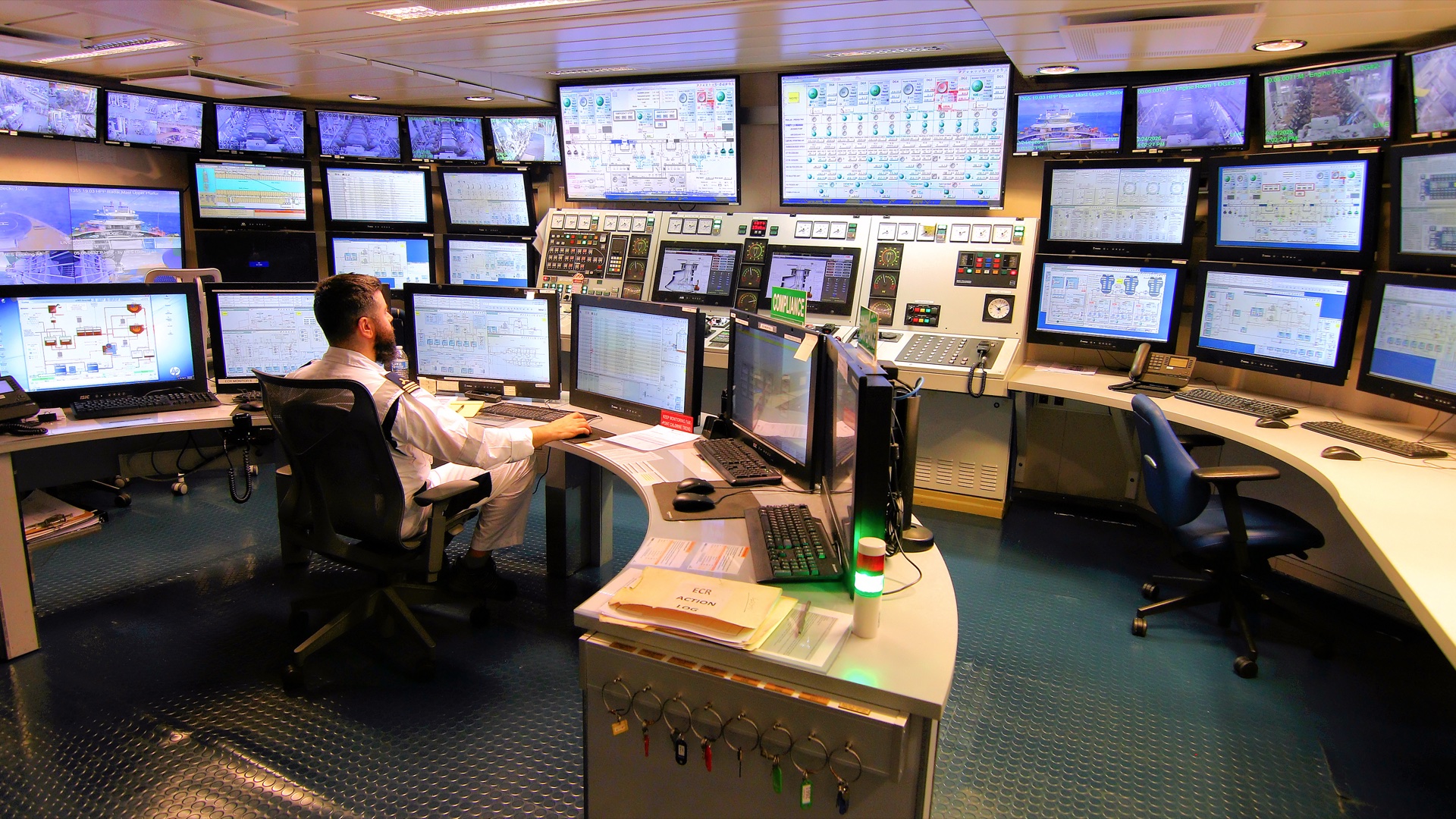
Hazardous area classification is the method used across various industries to identify locations where an explosive gas atmosphere may occur, allowing for the control of equipment and activities in those areas. In the maritime industry, this has long been applied to oil tankers, chemical tankers, and gas carriers.
With the use of LNG, methanol, LPG, ammonia and hydrogen as marine fuels, hazardous areas associated with bunkering stations, fuel preparation rooms, tank connection spaces and vent masts are now also found on container ships, passenger ships, bulk carriers and offshore vessels.
This article outlines the principles of hazardous area classification, its regulatory basis for ships, its relationship to the selection of equipment, its limitations and the conditions under which it remains valid in service.
Purpose and zone definitions
On ships that carry or use flammable liquids and gases, it is not possible to completely exclude releases from vents, relief valves, flanges, valve stems, and hose connections. Classification identifies locations where an explosive gas atmosphere may be present, allowing for the management of ignition sources in those areas, primarily through the careful selection, installation, and maintenance of appropriate equipment.
Hazardous areas are divided into zones according to the likelihood and duration of an explosive gas atmosphere.
| Zone | Explosive gas atmosphere | Examples from the IGF Code |
|---|---|---|
| Zone 0 | Present continuously, for long periods or frequently | Interiors of fuel tanks; pipes and equipment containing fuel |
| Zone 1 | Likely to occur occasionally in normal operation | Tank connection spaces; fuel preparation rooms; open deck within 3 m of a bunker manifold valve |
| Zone 2 | Not likely to occur in normal operation and, if it does occur, persisting for a short period only | Areas within 1.5 m of open or semi-enclosed Zone 1 spaces |
These examples illustrate the IGF Code's provisions for ships using natural gas as fuel; other fuels are subject to separate IMO interim guidelines with their own zone requirements (see Regulatory basis for ships, below).
Two aspects should be noted: (i) the zone indicates the likelihood and duration of an explosive atmosphere, not the severity of a possible fire or explosion, and (ii) a zone is a three-dimensional volume. A classification therefore specifies both the type of zone and its extent, including the vertical extent and the effect of openings, recesses and overhanging structures.
Basis of a classification
The zone assigned to a location is the result of an assessment. IEC 60079-10-1 sets out the general method. The principal factors are:
- the flammable substance and the conditions under which it is stored or handled;
- the sources of release and their grade, that is, whether a release is continuous, expected occasionally in normal operation or not expected in normal operation;
- the ventilation, in terms of its effectiveness in diluting a release and its availability;
- the geometry of the space and the openings through which gas may pass to adjacent spaces;
- the operating conditions assumed.
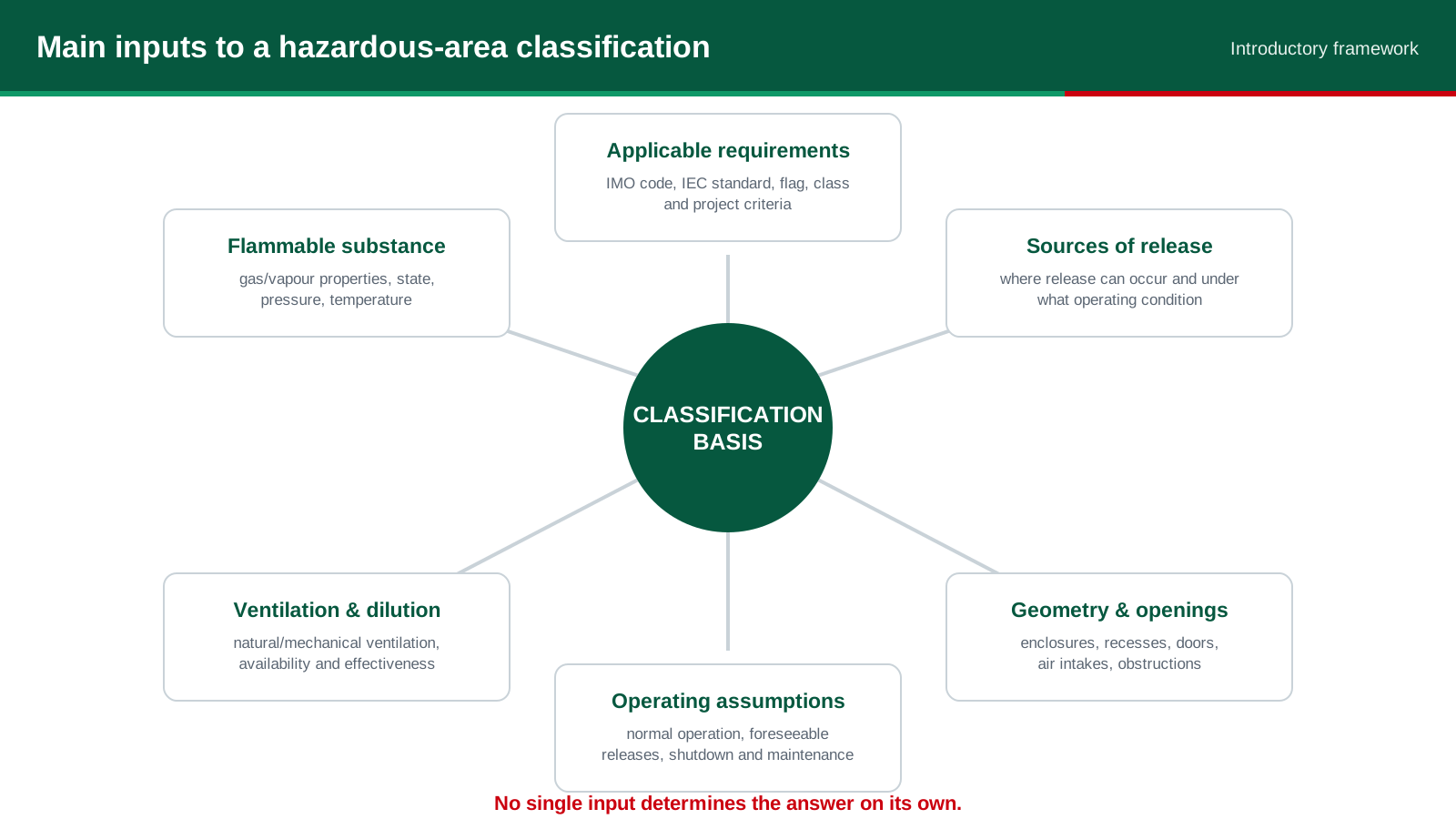 Main inputs to a hazardous area classification.Source: ICORA MED training diagram, from the course Fundamentals of Hazardous Area Classification for Maritime Applications.
Regulatory basis for ships
For ships, the applicable IMO instrument depends on the fuel:
- Natural gas: the IGF Code, Part A-1, chapter 12.
- Methyl and ethyl alcohol fuels: IMO interim guidelines, MSC.1/Circ.1621.
- LPG: IMO interim guidelines, MSC.1/Circ.1666.
- Ammonia: IMO interim guidelines, MSC.1/Circ.1687.
- Hydrogen: IMO interim guidelines, MSC.1/Circ.1701.
- Liquefied gases carried in bulk: the IGC Code.
For natural gas, chapter 12 lists the spaces and areas to be regarded as Zone 0, Zone 1 and Zone 2, as illustrated in the table above. The other guidelines have their own prescriptive distances and zone geometries, which differ from the natural-gas provisions and should not be assumed to be interchangeable. IEC 60092-502 provides marine electrical requirements for tankers, and for areas not addressed by the applicable prescriptive provisions, these instruments refer to recognised standards, including IEC 60092-502 and IEC 60079-10-1.
Two recent sets of amendments to the IGF Code affect these provisions. Resolution MSC.551(108), in force since 1 January 2026, includes interbarrier spaces in Zone 0, instead of Zone 1, for ships constructed on or after that date. Resolution MSC.567(109), expected to enter into force on 1 January 2028 subject to tacit acceptance on 1 July 2027, introduces for ships constructed on or after that date a Zone 1 area around a fuel tank vent mast outlet defined as an unlimited-height vertical cylinder of 6 m radius centred on the outlet, together with a hemisphere of 6 m radius below it, with Zone 2 extending 4 m beyond those boundaries. A reduced Zone 1 may be accepted where ship size or layout prevents these distances being maintained, based on a dispersion analysis. The provisions applicable to a particular ship therefore depend on its date of construction as defined in the Code.
Because the extent of a zone is measured from specific sources of release and openings, a hazardous area plan is specific to the individual ship. Differences in the position of vent outlets, doors or ventilation inlets between otherwise similar ships may change the classification of adjacent spaces.
Case example: Border Heather
The explosion and fire on the product tanker Border Heather at Grangemouth in October 2004, investigated by the UK Marine Accident Investigation Branch (MAIB), illustrates how a non-hazardous designation depends on the barriers assumed.
After the ship had loaded motor spirit, cargo passed from the cargo system into the gas-freeing system: a spectacle plate had not been fitted in the blanked position, isolating valves had not been closed and a non-return valve leaked. Motor spirit and vapour entered the gas-freeing fan room and drained to the bow thruster room below, where the vapour was ignited by electrical equipment not intended for use in an explosive atmosphere. There were no injuries; the ship sustained significant damage.
The gas-freeing room shows how a classification can depend on which criteria are applied to it. Under the applicable IEC 60092-502 criteria, the room appeared correctly classified as non-hazardous. MAIB's inspectors, however, read a separate provision in the classification society's own Rules — under which a dangerous zone may arise from any piping system with openings through which leakage may occur — as pointing to a hazardous classification; the classification society itself maintained the non-hazardous classification. Had the room been classified as dangerous, the MAIB considered, the electrical and drainage arrangements would probably have been specified differently, and the accident probably prevented.
It recommended that a unified requirement be proposed to the International Association of Classification Societies (IACS), under which any space associated with or containing piping that is at any time connected to a tanker's cargo system is considered a dangerous space, together with suitable monitoring for explosive atmospheres in such spaces.
Selection of equipment
The IGF Code permits electrical equipment and wiring in hazardous areas only where essential for operational purposes or safety enhancement. It requires such equipment to be evaluated and certified or listed by an accredited testing authority or notified body recognised by the Administration.
Equipment is selected on the basis of the classification. Three parameters establish minimum compatibility with the zone:
- Equipment protection level (EPL), the normal minimum required for the zone: Ga for Zone 0, Gb for Zone 1 and Gc for Zone 2. Equipment with a higher protection level than the zone requires is also suitable for it.
- Gas group (IIA, IIB or IIC), which corresponds to the ignition characteristics of the substance. IIC is the most demanding and covers equipment marked for IIB and IIA.
- Temperature class (T1 to T6), which limits the maximum surface temperature of the equipment, from 450 °C for T1 to 85 °C for T6, so that it remains below the auto-ignition temperature of the substance.
Matching these parameters is necessary but not on its own sufficient: full suitability also depends on the equipment's type of protection, any conditions of use stated on its certificate, and installation in accordance with the certificate and the manufacturer's instructions.
These parameters appear in the equipment marking. For example, the marking Ex db IIC T4 Gb denotes a flameproof enclosure (db) suitable for gas group IIC, and therefore also for IIB and IIA, with a maximum surface temperature of 135 °C (T4) and an equipment protection level appropriate to Zone 1 (Gb).
The properties of the fuel determine the gas group and temperature class required. In the IEC data for gas and vapour classification, methane, methanol and ammonia are assigned to group IIA (temperature class T1, or T2 for methanol) and hydrogen to group IIC (T1). Equipment certified only for group IIA or IIB is therefore not suitable for hydrogen, and a change of fuel requires the classification and the equipment selection to be reviewed.
Limitations of hazardous area classification
Hazardous area classification addresses the likelihood that an explosive gas atmosphere is present. The following matters are outside its purpose and are addressed by other means.
- Consequences. The classification does not indicate the size of a possible fire or explosion, the persons exposed or the potential for escalation. IEC 60079-10-1 also excludes catastrophic failures, such as the rupture of a tank or pipeline, from its scope. These scenarios are addressed through risk assessment.
- Toxicity. The IMO interim guidelines for ships using ammonia as fuel define toxic areas and toxic spaces in addition to hazardous areas. Minimum toxic areas include, for example, open deck areas within 10 m of flanges, valves and other potential leakage sources; other outlets have different prescribed distances, and a dispersion analysis is additionally required. The guidelines refer to both hazardous and toxic area plans for the ship.
- Operational safety zones. For LNG bunkering, ISO 20519 distinguishes hazardous zones from the safety zone, an area around the bunkering station restricted to essential personnel and activities during bunkering, and from the wider monitoring and security area. These zones are determined on different bases, and the boundary of one should not be taken as the boundary of another.
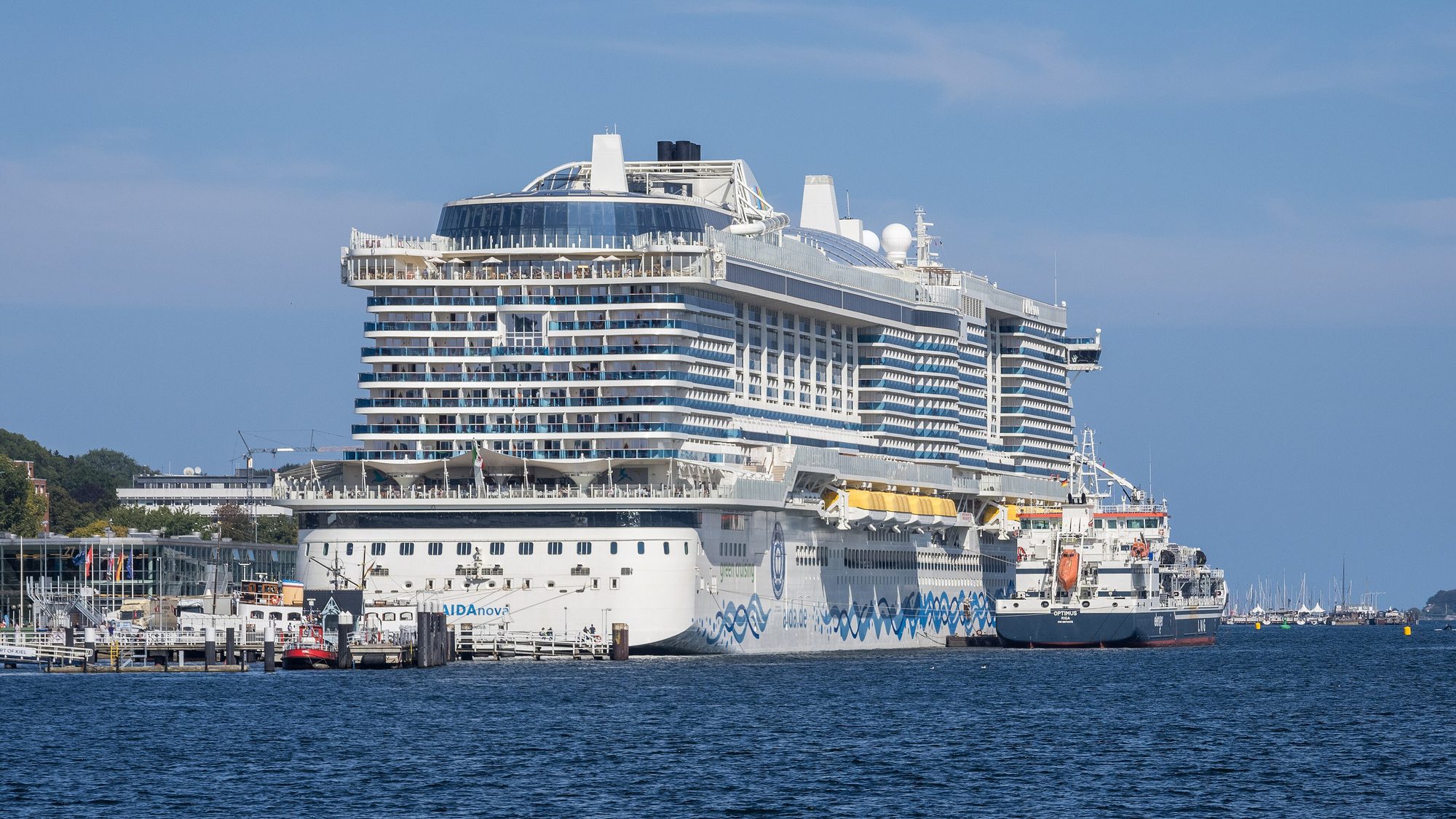 LNG bunkering at Kiel, 2024: the cruise ship AIDAnova with the bunker tanker Optimus alongside.Source: JoachimKohler-HB, Wikimedia Commons, licence CC BY-SA 4.0; resized.
Maintaining the classification in service
The classification and the associated equipment selection remain valid while the installation corresponds to the conditions on which they were based. IEC 60079-14, IEC 60079-17 and IEC 60079-19 address, respectively, the design, selection and installation, the in-service inspection and maintenance, and the repair of equipment for explosive atmospheres.
Conditions that can impair the protection provided by certified equipment include missing or incorrect fasteners on flameproof enclosures, damaged or painted flamepath surfaces, unauthorised modifications such as additional cable entries, replacement of certified components with non-certified items, and the use of non-certified portable equipment in hazardous areas.
Modifications to the ship may also affect the basis of the classification. Examples are the relocation of a vent outlet, the enclosure of an open deck area, changes to ventilation arrangements, the installation of additional equipment and conversion to a different fuel. Such changes should be assessed for their effect on the hazardous area plan and on the suitability of the installed equipment.
When a hazardous area plan is reviewed, the following points may be considered:
- the applicable IMO instrument or fuel-specific guideline, its amendment level, and the ship's construction date relative to that amendment;
- the fuel or cargo on which the plan is based, and the corresponding gas group and temperature class;
- whether all sources of release are identified and the extent of each zone is defined in three dimensions;
- the assumptions made regarding ventilation, doors and airlocks, and the effect of their failure;
- the suitability of fixed and portable equipment within each zone.
Competence
IEC 60079-10-1 contains provisions on the competence of personnel who carry out area classification, and the IECEx Certification of Personnel Competence Scheme includes a specific unit of competence for this activity (Unit Ex 002, Perform classification of hazardous areas).
Other personnel use the classification without performing it, including designers, technical superintendents, surveyors, ships' officers, personnel responsible for bunkering and permit-to-work systems, and participants in risk assessment workshops. For these users, an understanding of the meaning, basis and limitations of the hazardous area plan supports the decisions for which they are responsible.
Conclusion
Hazardous area classification identifies where an explosive gas atmosphere may occur, and with what likelihood, as a basis for the control of sources of ignition. On ships it is prescribed by the applicable IMO Codes or fuel-specific guidelines, together with the associated IEC standards, and it remains valid while the assumptions on which it is based are maintained. As alternative fuels extend hazardous areas to further ship types, more personnel need to interpret hazardous area plans, including their basis and their limitations.
ICORA MED provides a course on this subject, Fundamentals of Hazardous Area Classification for Maritime Applications, for marine engineers, ships' officers, technical superintendents, surveyors and risk professionals who use or review hazardous area plans.
References
- International Electrotechnical Commission. IEC 60079-0:2026, Explosive atmospheres – Part 0: Equipment – General requirements. Link
- International Electrotechnical Commission. IEC 60079-10-1:2020, Explosive atmospheres – Part 10-1: Classification of areas – Explosive gas atmospheres. Link
- International Electrotechnical Commission. IEC 60079-14:2024, Explosive atmospheres – Part 14: Electrical installation design, selection and installation of equipment, including initial inspection. Link
- International Electrotechnical Commission. IEC 60079-17:2023, Explosive atmospheres – Part 17: Electrical installations inspection and maintenance. Link
- International Electrotechnical Commission. IEC 60079-19:2025, Explosive atmospheres – Part 19: Equipment repair, overhaul and reclamation. Link
- ISO/IEC 80079-20-1:2017, Explosive atmospheres – Part 20-1: Material characteristics for gas and vapour classification – Test methods and data. Link
- International Electrotechnical Commission. IEC 60092-502:1999, Electrical installations in ships – Part 502: Tankers – Special features. Link
- International Maritime Organization. International Code of Safety for Ships using Gases or other Low-flashpoint Fuels (IGF Code), resolution MSC.391(95), chapter 12: Explosion prevention, and chapter 14: Electrical installations. Link
- International Maritime Organization. Resolution MSC.551(108), Amendments to the IGF Code, adopted 23 May 2024. Link
- International Maritime Organization. Resolution MSC.567(109), Amendments to the IGF Code, adopted 6 December 2024. Link
- International Maritime Organization. International Code for the Construction and Equipment of Ships Carrying Liquefied Gases in Bulk (IGC Code), resolution MSC.370(93), chapter 10: Electrical installations. Link
- International Maritime Organization. Interim guidelines for the safety of ships using methyl/ethyl alcohol as fuel (MSC.1/Circ.1621), 2020. Link
- International Maritime Organization. Interim guidelines for the safety of ships using LPG fuels (MSC.1/Circ.1666), 2023. Link
- International Maritime Organization. Interim guidelines for the safety of ships using ammonia as fuel (MSC.1/Circ.1687), 2025. Link
- International Maritime Organization. Interim guidelines for the safety of ships using hydrogen as fuel (MSC.1/Circ.1701), 2026. Link
- International Organization for Standardization. ISO 20519:2021, Ships and marine technology – Specification for bunkering of liquefied natural gas fuelled vessels. Link
- IECEx. Certification of Personnel Competence Scheme, units of competence. Link
- UK Marine Accident Investigation Branch. Report 5/2006: Explosion and fire on coastal tanker Border Heather after loading a volatile cargo of motor spirit at Grangemouth Docks, Scotland. Link