Maritime risk assessment is not simply a compliance exercise or a completed risk matrix; it is a structured process for understanding what can go wrong, how serious the consequences could be, and what can reasonably be done to control the risk. As maritime operations become more technologically complex, this basic discipline is becoming more important, not less.
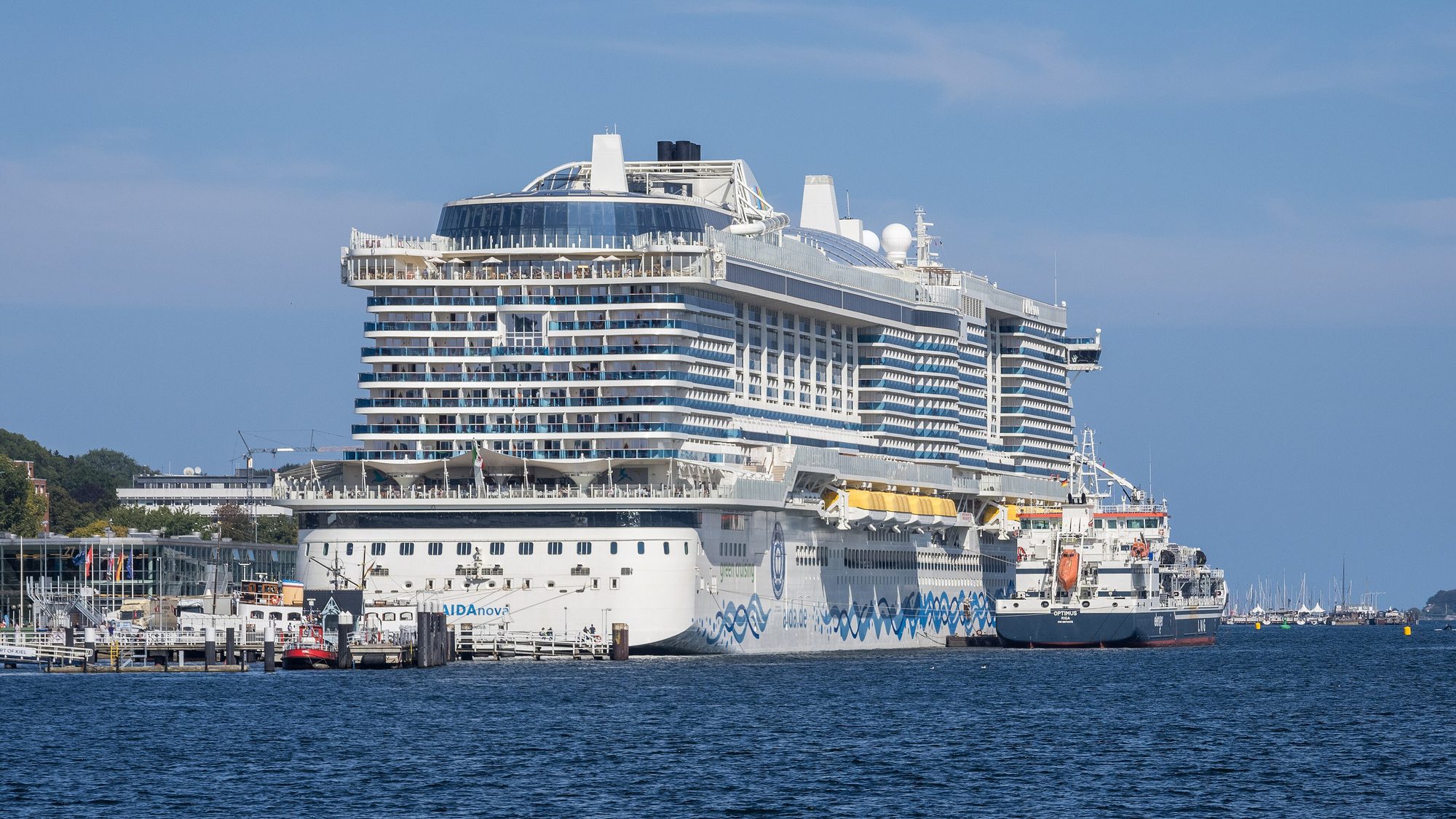
Ships, ports, terminals, offshore facilities, and maritime projects operate in environments where technical systems, people, weather, traffic, infrastructure, and organisational decisions interact. A failure rarely develops in complete isolation. Recent maritime safety research increasingly reflects this reality, moving from simple linear accident explanations towards models that examine interactions between human, organisational, technical, operational, and environmental factors.
A risk assessment is not simply a compliance exercise or a completed matrix. It is a structured decision process: define the operation, identify credible hazards, analyse how scenarios can develop, evaluate the significance of the risk, select controls that change the risk, and preserve enough evidence to revisit the decision later.
This article uses the terminology of risk management in a deliberately practical way. ISO 31000 distinguishes risk identification, risk analysis, and risk evaluation within the wider risk-assessment process, while IMO Formal Safety Assessment (FSA) applies a related structured logic to maritime rule-making. The terminology matters because each stage answers a different question, and because mixing the stages can obscure the reasoning behind a safety decision.
1. Start with the operation, not the matrix
The first question in a risk assessment is not whether a risk is "red", "amber", or "green". It is what exactly is being assessed?
The operating context needs to be explicit: the vessel or facility, the activity, location, environmental conditions, people involved, interfaces with other organisations, expected operating modes, and reasonably foreseeable abnormal situations. The same nominal task may present materially different risks in open water, a congested port approach, an exposed anchorage, or during degraded equipment conditions.
This distinction matters because marine casualties commonly develop through combinations of conditions rather than a single isolated failure. Accident investigation reports, casualty analyses, and research literature all contribute evidence on these interactions. IMO's casualty-investigation framework is expressly intended to identify contributing factors so that recurrence can be prevented, while FSA provides a prospective structure for examining risks before an event occurs. For an assessment, the practical implication is the same: describe the real operation sufficiently well before attempting to score or quantify its risk.
2. Hazard identification: what could go wrong?
Hazard identification establishes the scenarios that require further analysis. Depending on the activity, these may include collision, grounding, loss of propulsion or steering, fire, loss of containment, toxic exposure, mooring failure, enclosed-space incidents, machinery failure, pollution, cyber-related loss of critical functions, or limitations in emergency response.
The IMO Formal Safety Assessment (FSA) framework expresses the opening question simply: what might go wrong? Its subsequent steps consider the associated risks, risk-control options, the costs and benefits of those options, and recommendations for decision-making. FSA was developed for IMO rule-making, but its sequence provides a useful illustration of disciplined maritime risk reasoning.
Hazard identification also needs to extend beyond equipment failure alone. A useful scenario description considers initiating events, enabling conditions, human and organisational influences, safeguards, and credible escalation. A machinery failure, for example, may be manageable in one context but become a grounding or collision scenario when combined with traffic, weather, limited sea room, delayed detection, or ineffective recovery actions.
The practical point is simple: naming a hazard is only the beginning. The assessment needs to explain how the scenario can develop and what prevents that development.
3. Risk assessment, analysis, and evaluation
The terms risk assessment, risk analysis, and risk evaluation are often used interchangeably in operational discussions, but they are not the same. ISO 31000:2018 frames risk management as a process built around establishing the context and then identifying, analysing, evaluating and treating risk, with communication and consultation, and monitoring and review, continuing throughout rather than sitting only at either end. Risk assessment is the name for the middle three stages together: risk identification, risk analysis, and risk evaluation. Risk analysis examines the nature and level of identified risks; risk evaluation compares the analysed risks against defined criteria to determine whether further treatment is required. Applying this structure consistently, while drawing on IMO Formal Safety Assessment (FSA) for maritime-specific reasoning, keeps the logic clear and makes an assessment easier to audit or revisit.
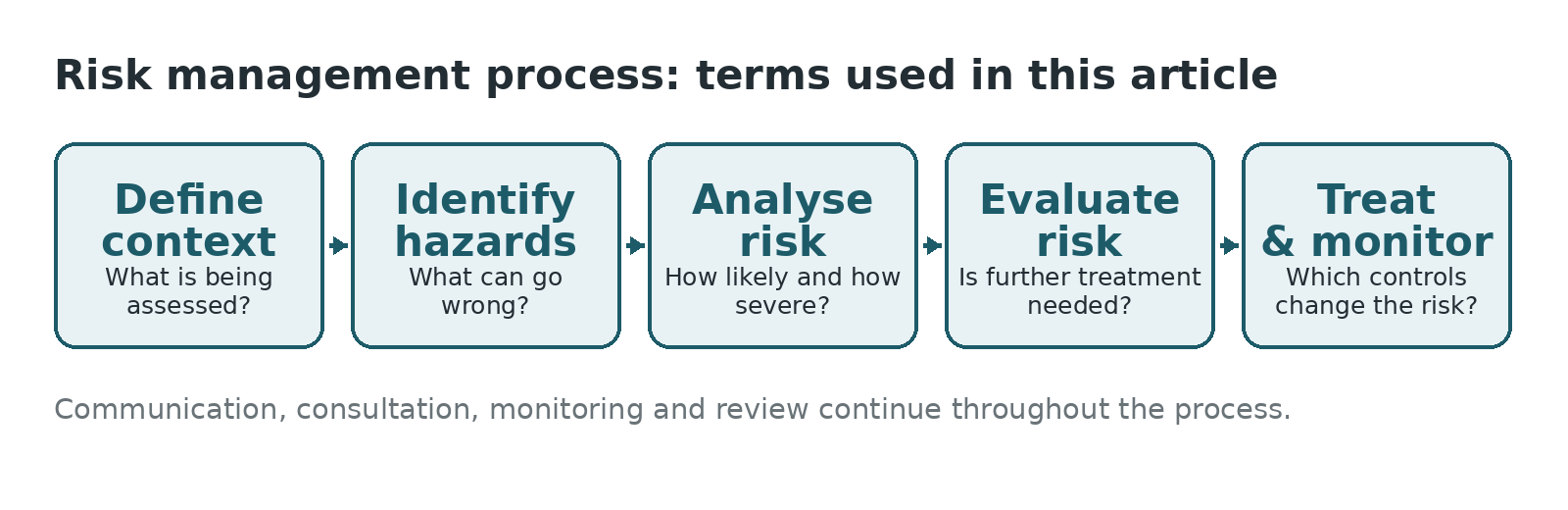 Risk management process used in this article, aligned with ISO 31000:2018.
4. Analyse the risk with a method proportionate to the decision
Risk analysis examines the likelihood of an unwanted event, the severity and range of its consequences, the performance of existing controls, and the uncertainty in the evidence. The appropriate technique depends on the decision being made, the complexity of the system, and the quality of available data.
A relatively straightforward operation may be assessed effectively through a structured workshop supported by a qualitative or semi-quantitative matrix. More complex systems may require bow-tie analysis, fault trees, event trees, failure-mode analysis, simulation, Bayesian networks, or other probabilistic methods. These methods can expose causal dependencies and barrier interactions that a simple matrix cannot represent, but added sophistication does not remove uncertainty. Data quality, model assumptions, expert judgement, sensitivity, and validation remain fundamental.
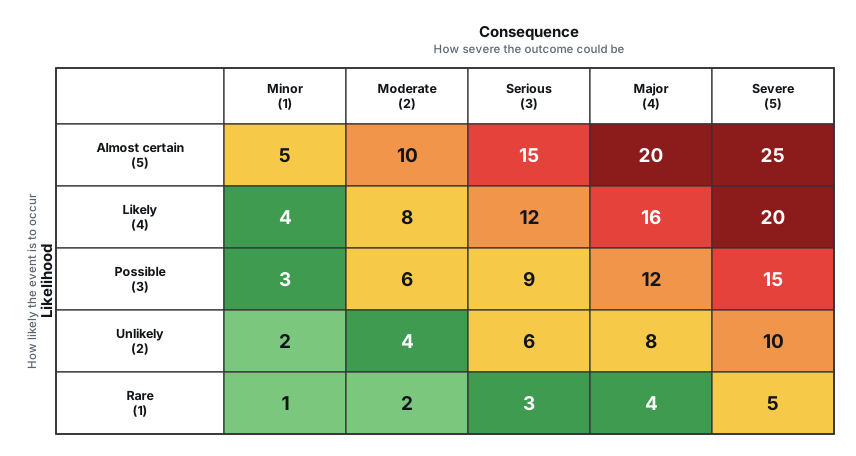 Illustrative 5 × 5 risk matrix
The numerical score is a screening aid, not a substitute for scenario description, evidence, uncertainty, or professional judgement.
A matrix is therefore most useful when its categories, criteria, and assumptions are defined in advance. It becomes misleading when a numerical product is treated as precise evidence, when very different scenarios collapse into the same cell, or when the score is detached from the controls and assumptions on which it depends.
5. Evaluate the risk, then select controls that change it
Risk evaluation compares the results of the analysis with the organisation's risk criteria. The question changes from "what is the risk?" to "what decision follows from it?" Depending on the framework, the outcome may be acceptance, acceptance subject to conditions, or a requirement for further risk treatment.
An effective assessment does not finish with a score. It identifies measures that can influence the likelihood of the event, its consequences, exposure to the hazard, or the reliability of the barriers between an initiating event and harm. Controls may include design modification, physical protection, equipment redundancy, monitoring and alarms, maintenance, operational limits, procedures, competent staffing, training, traffic management, emergency arrangements, or combinations of these measures.
The emphasis is on effective controls, not simply more controls. A control that is unavailable, poorly maintained, impractical under real operating conditions, or dependent on an unrealistic human response may provide little risk reduction despite appearing strong on paper. The assessment therefore needs to consider how controls perform as a system, including dependencies between technical safeguards, alarms, operator actions, organisational arrangements, and emergency response.
6. The risk landscape is changing
The fundamentals of risk assessment remain stable, but the systems and hazards being assessed are changing quickly.
Alternative fuels. LNG, methanol, LPG, ammonia, and hydrogen introduce different combinations of flammability, toxicity, cryogenic exposure, pressure, containment, ventilation, hazardous-area, and competence requirements. IMO has developed fuel-specific provisions, including the interim guidelines for ships using ammonia as fuel. These developments expand the scenarios and safeguards that need to be considered without changing the basic discipline of defining context, analysing risk, and selecting proportionate controls.
Digitalisation and cyber risk. Connected navigation, machinery, cargo, communication, and shore-support systems create dependencies that can affect safety and operational continuity. IMO's Guidelines on Maritime Cyber Risk Management organise cyber risk management around identifying, protecting, detecting, responding to, and recovering from cyber-related events.
Autonomous and remotely operated ships. These systems add questions concerning software, connectivity, remote operations, system dependability, human oversight, and the definition of the operational context. In May 2026, IMO adopted the non-mandatory International Code of Safety for Maritime Autonomous Surface Ships (MASS Code), which took effect on 1 July 2026 and uses a goal-based framework for remotely controlled and autonomous operations.
These developments broaden the system boundary. They do not remove the need for established risk-assessment principles; they make clarity about interfaces, dependencies, assumptions, and uncertainty even more important.
7. Documentation is part of the assessment
A risk assessment is only as useful as the reasoning that can be reconstructed afterwards. The record needs to make clear what was assessed, which hazards and scenarios were identified, what evidence and assumptions were used, how likelihood and consequence were evaluated, what existing controls were credited, what additional measures were selected, and what residual risk remained. Responsibilities, decisions, limitations, and conditions requiring reassessment also need to be traceable.
This is consistent with the International Safety Management (ISM) Code, whose objectives include assessment of identified risks to ships, personnel, and the environment, together with the establishment of appropriate safeguards.
Good documentation therefore does more than demonstrate that a workshop occurred. It preserves the basis of the safety decision and makes later review possible when the operation, equipment, evidence, or assumptions change.
8. Risk assessment as a living decision process
The most useful maritime risk assessments are neither unnecessarily complex nor artificially precise. They are proportionate to the decision, transparent about uncertainty, and sufficiently detailed to explain why particular controls were selected.
Risk assessment is strongest when it can be updated as conditions, evidence, and barrier performance change, not when it is treated as a static snapshot.
As ships, fuels, digital systems, and operating environments change, the basis of an assessment can change with them. New information may become available during an operation; equipment condition and barrier performance may deteriorate; interfaces may change; and operating limits may be exceeded or revised. Reassessment is therefore required when changes are material to the assumptions or controls on which the original decision depended.
Dynamic risk modelling can support this principle in complex or data-rich applications by updating estimates as operational evidence changes. It is not a requirement for every assessment. The underlying discipline remains the same: know the context, understand the scenarios, make uncertainty visible, select controls that materially change the risk, and keep the decision traceable.
Conclusion
Maritime risk assessment is a disciplined way of connecting hazards, evidence, uncertainty, controls, and decisions. Its value does not come from the matrix or model alone. It comes from a clear definition of the operation, credible scenario development, proportionate analysis, explicit evaluation criteria, effective risk controls, and documentation that allows the reasoning to be understood and revisited.
As alternative fuels, cyber-connected systems, and autonomous operations expand the range of maritime risks, the need for this discipline becomes greater. More advanced methods can strengthen the analysis where the decision warrants them, but they remain tools within a wider risk-management process rather than substitutes for it.
Seats available: Further exploration of the topic, please enrol in the Fundamentals of Maritime Risk Assessment Course!
References
- International Maritime Organization. Formal Safety Assessment (FSA). Link
- International Maritime Organization. Revised Guidelines for Formal Safety Assessment (FSA) for use in the IMO rule-making process, MSC-MEPC.2/Circ.12/Rev.2. Link
- International Organization for Standardization. ISO 31000:2018, Risk management — Guidelines. Link
- International Maritime Organization. Casualty Investigation Code and marine casualty investigation framework. Link
- International Maritime Organization. Interim Guidelines for the Safety of Ships Using Ammonia as Fuel, MSC.1/Circ.1687. Link
- International Maritime Organization. Guidelines on Maritime Cyber Risk Management. Link
- International Maritime Organization. International Code of Safety for Maritime Autonomous Surface Ships (MASS Code), resolution MSC.595(111). Link
- International Maritime Organization. International Safety Management (ISM) Code. Link